

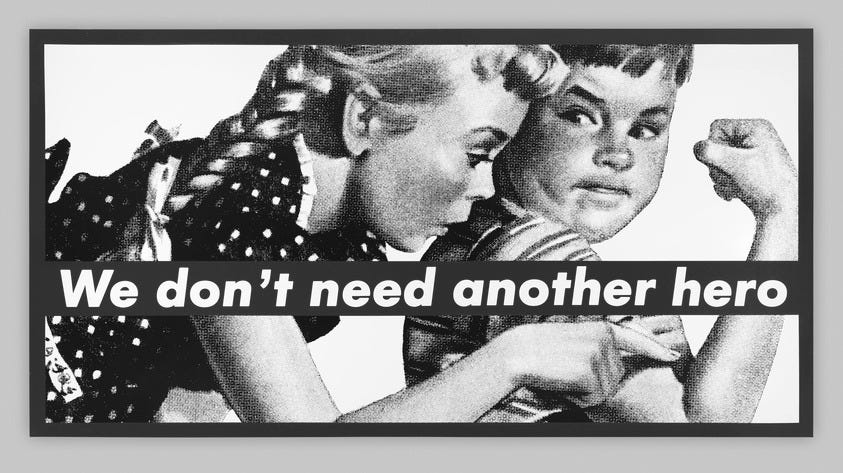
We Don't Need Another Hero.
Questioning ambition and the drum major instinct.
My friend and I were chatting about the self-help industry this weekend, and ooooo we both had stories! Once, my assignment photographing a self-help personality was cancelled after they sent a long, rampaging email mocking her staff and peers. Similarly, friend told me about a popular podcaster who arrived at a speaking engagement in a messy state: all hopped up and in a cruel mood. They seemed more in need of help than equipped to dispense it.
These gurus got my friend and I talking about the hero’s journey. The story structure of an adventure - typically one given, not chosen - with unforeseen obstacles and a lesson that leads to glory, victory, or resolution. But heroes never seem all that happy- their rewards are fame, wealth, greater responsibility, and a further distance to fall. Exorbitant wealth and fame are fickle, and they seem to spoil whatever and whoever they touch. There’s no real comfort in them, no lasting or enduring ease. I wonder if once you become a professional hero, the role becomes too calcified to allow for the flexibility that life requires. The real world is distant from up there on that pedestal.
More realistically, we’ll experience not the hero’s journey but the learner’s journey. The state of being human. Life is less about a pathway to redemption and more about cycles of order and disorder and reorder, and every time we find ourselves in that cycle it looks different. My friend told me a teacher explained that it may be unending, but it can help simply to recognize where we are in the pattern.
I’ve been thinking about how my job as a photojournalist is to meet someone at various points of the falling-apart, putting-back-together parts of humanity. What we could improve upon, as storytellers, is realizing that most stories don’t end, they keep going. It’s more of an ellipses than a period. Our job is to portray as much nuance and complexity as best we can. Sometimes, I question how well I can do that in images. And I worry that we’ve been too complicit in elevating heroes who end up just being human after all. Or, on the flip side, portraying problems without possibility. If I can use a music metaphor: the song can be happy or sad, but we need to hear all the notes. The backup singer is just as needed as the lead vocalist.
One of my favorite speeches by Martin Luther King Jr. is a sermon given in 1968 called the Drum Major Instinct, in which he warns against the pull towards the front of the metaphorical band, rather than finding our own instrument and playing it well. What happens if we march past everyone rather than finding our place alongside each other?
And you know, we begin early to ask life to put us first. Our first cry as a baby was a bid for attention. And all through childhood the drum major impulse or instinct is a major obsession. Children ask life to grant them first place. They are a little bundle of ego. And they have innately the drum major impulse or the drum major instinct. Now in adult life, we still have it, and we really never get by it. We like to do something good. And you know, we like to be praised for it. Now if you don't believe that, you just go on living life, and you will discover very soon that you like to be praised. Everybody likes it, as a matter of fact. And somehow this warm glow we feel when we are praised or when our name is in print is something of the vitamin A to our ego. Nobody is unhappy when they are praised, even if they know they don't deserve it and even if they don't believe it.
[...]
It is the drum major impulse and longing that runs the gamut of human life. And so we see it everywhere, this quest for recognition. And we join things, overjoin really, that we think that we will find that recognition in. Now the presence of this instinct explains why we are so often taken by advertisers. You know, those gentlemen of massive verbal persuasion. And they have a way of saying things to you that kind of gets you into buying. In order to be a man of distinction, you must drink this whiskey. In order to make your neighbors envious, you must drive this type of car. In order to be lovely to love you must wear this kind of lipstick or this kind of perfume. And you know, before you know it, you're just buying that stuff.
[...]
There comes a time that the drum major instinct can become destructive. And that's where I want to move now. I want to move to the point of saying that if this instinct is not harnessed, it becomes a very dangerous, pernicious instinct.
[...]
Nations are caught up with the drum major instinct. "I must be first." "I must be supreme." "Our nation must rule the world." And I am sad to say that the nation in which we live is the supreme culprit. And I'm going to continue to say it to America, because I love this country too much to see the drift that it has taken.
[…}
Yes, if you want to say that I was a drum major, say that I was a drum major for justice. Say that I was a drum major for peace. I was a drum major for righteousness. And all of the other shallow things will not matter. I won't have any money to leave behind. I won't have the fine and luxurious things of life to leave behind. But I just want to leave a committed life behind.
Thanks for indulging that long excerpt.
Sometimes thoughts or themes eddy in my mind and they stick around until I put them somewhere, like a good conversation or maybe now here on Substack. This week, I mulled over the idea of perpetual self help in pursuit of heroism and how quickly it flattens us. And how alluring these archetypes can be in journalism or storytelling. Or just in our lives. I got the Radiohead line “Ambition makes you look pretty ugly” stuck in my head. It’s not ambition itself that can be ugly, the type of ambition that is in service to our inner selves or an outer duty can be gorgeous. It’s needed and worthwhile. But the machine of ambition, the kind of upward mobility that only goes up and not out, or to the side, or stop when it’s time? That’s when it can be corrosive. There’s a privilege in examining ambition, but I also think it’s needed if we are to take on the learner’s journey. Or arrive at some kind of contentedness.
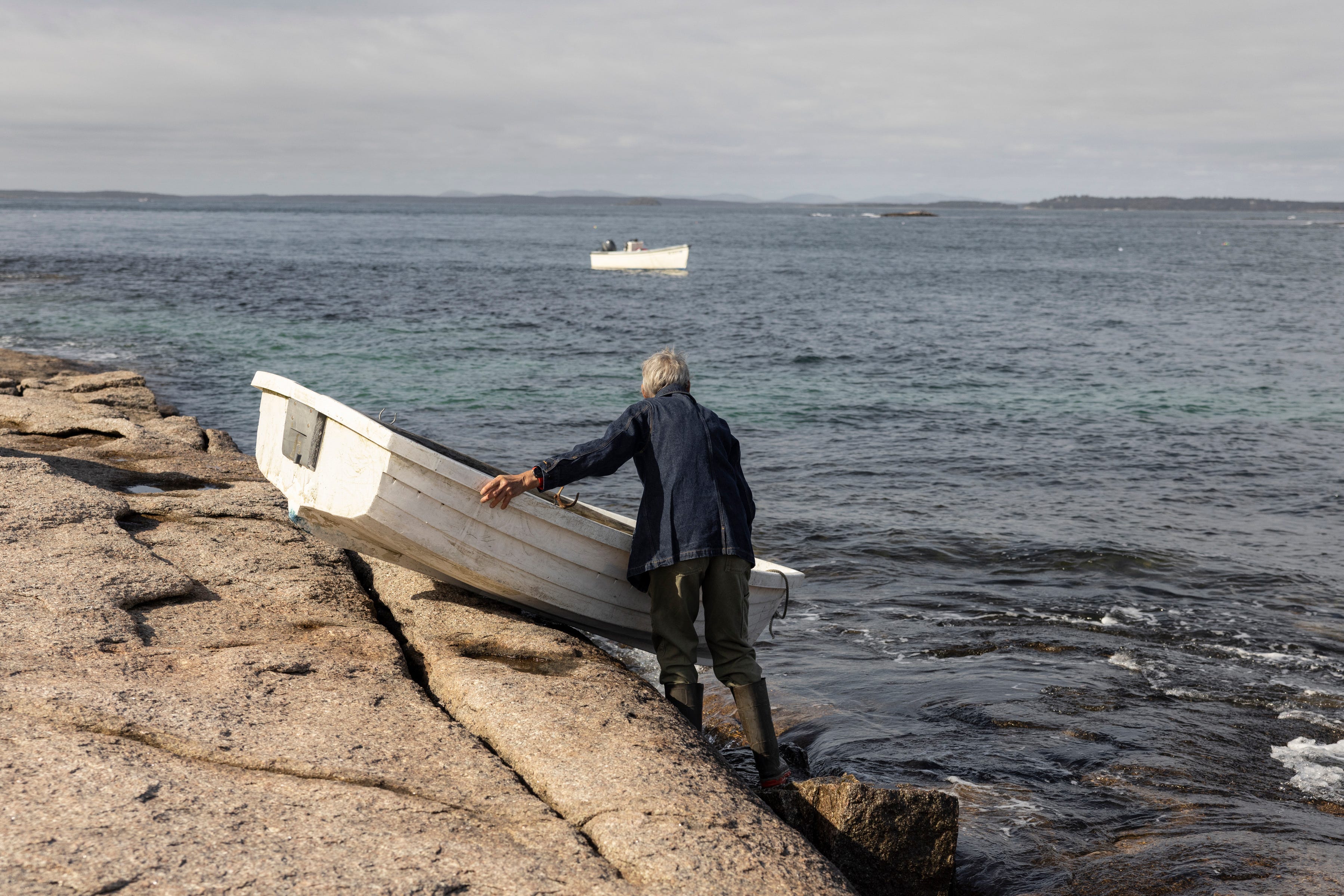
There’s a saying in my family: “so much for heroes.” We’ve found ourselves saying it a lot lately: when the politician gets caught up in a scandal, when the pop star says something disappointing. People seem to get into a lot of trouble, that whole order and disorder, chaos and ease thing is awfully real. I’d rather have public servants, or people who say “actually, I have enough money”, and more articles about background singers or the third-chair violinist. I’ve never been on a yacht, but it doesn’t seem that happy up there. I have, however, been on many rowboats with smiling people rowing towards or from a day of satisfying work. Perhaps I want to dream about the rowboat. And dispense of the pedestal.
Delights:
Fiona Apple’s cover of Neil Young’s Heart of Gold:
This SNL skit felt personal and had me giggling:
"I’ve been thinking about how my job as a photojournalist is to meet someone at various points of the falling-apart, putting-back-together parts of humanity." Letting these words sink in - thank you, Greta.
So timely (even though I'm arriving quite late to this post). Thank you Greta xx